Monday, September 28, 2009

A Person Of Interest

Re: Valerie

(I am replying here to post pictures) I agree that Rosenberg should not have been a credible source in this case. As I said... If I were covering this story, I would never use Hatfill's identification because there was no hard evidence to prove he could be convicted.

The handwriting on the envelopes of anthrax powder is very distinguishable. And I think if the FBI asked Hatfill for a writing sample that he would not have remained a "person of interest." Detectives can identify characteristics within an individuals handwriting quite easily...

Although the FBI claims only 30 people in the US have the knowledge to do this. And even though the FBI eventually announced
Bruce Edwards Ivins was responsible ... I really think that it is apparent that somebody from Al-Qaeda perpetrated the anthrax attacks.

Envelope & Letter Containing Anthrax
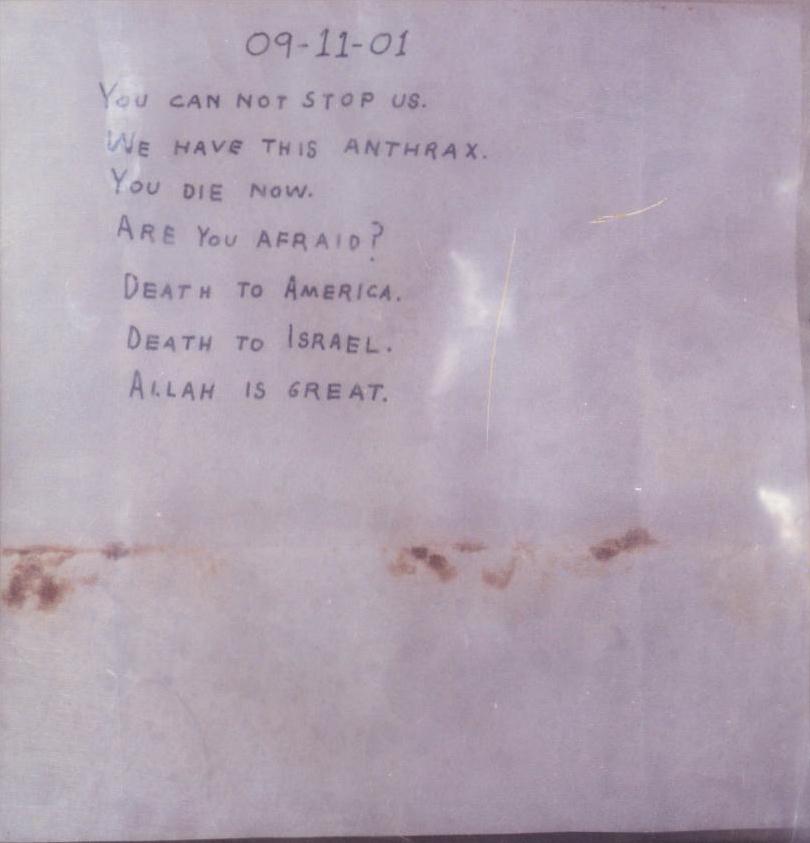
The image “http://upload.wikimedia.org/wikipedia/commons/0/0a/Daschle_letter.jpg” cannot be displayed, because it contains errors.

File:Nbcanthraxletter.jpg


I think as prospect and working journalists, we must take into consideration:
  • What did we learn from this assignment?
  • And how will it make us stronger as journalists?
In response to Hatfill's case... I think that journalists should consider concealing the identity of a "person of interest" or a suspect to avoid destroying a person's reputation, in the event they are never formally convicted.

I believe that by keeping a person's identification confidential unless there is sufficient evidence to charge them under the legislation, will not induce the general public to shun an innocent individual or inhibit a journalist from generating groundbreaking coverage.
For example New York Times journalist, Nicholas D. Kristof referred to Hatfill as Mr. Z in the majority of his articles about this investigation. Also if all the journalists whom covered this story addressed Hatfill by his initials or Mr. Z, and not had used his real name, unless he were charged for the anthrax attacks, it would not have destroyed his personal life to the same extent.

Although Hatfill had legitimate reasons to charge the US Department of Justice and Donald Foster with defamation
. And he also might not have deserved the extensive media coverage either.

I can't feel sorry for Hatfill since he blames the world for his problems. At the end of the day, the negative coverage did not ruin his life. I think it is safe to say that Hatfill devastated his own life by forging educational credentials on his resume. And I think that is malice itself. Not only did he lie and cheat with his employers and career, he lied and cheated on himself, as well as his friends and the educational institution.
And it looks like we are watching Hatfill getting a taste of his own medicine... Hatfill possessed poor morales and values, and that should hurt him the most. "Two wrongs, don't make a right", and I think I am being brutally honest, and not malicious.

Sunday, September 27, 2009

A person of interest ...

As I tried to squish everything I had down to 750 words for our "Person of Interest" assignment I came across some very fascinating information about Dr. Steven J Hatfill, aka "Mr. Z" - most importantly that Dr. Hatfill was exonerated by the FBI in 2008 of any association in the anthrax attacks.

As I read and read and read through articles about the anthrax attacks, Dr. Hatfill, and the F.B.I.'s investigation I began to see how important it is to question all sources of information and evidence - especially if the evidence is circumstantial. We had discussed linkage in our last class - and it is something I saw a lot of when reviewing our assignment and articles. In the New York Times article, "
New Details on F.B.I.'s False Start in Anthrax Case" Dr. Hatfill's lawyer, Mark A. Grannis was quoted saying "... an accumulation of claims from acquaintances can cast an innocent person in a highly suspicious light." Never is this more true, especially when the innocent person is in the line of some very public scrutiny. Just look at the damage that Dr. Barbara Rosenberg's gossipy comments through the FAS forums had done. I really did not know that a lifelong academic pursuit of microbiology would equip someone with the psychological expertise of a criminal profiler! It's amazing how easy it is to link someone to an action with a little bit of imagination and a desire to "pin the perp". Our society demands such swift justice that we tend to avoid steady reason and opt for a brut force reaction.

Here are a few links about Dr. Hatfill & the Anthrax Investigation:

New York Times' topics page on Dr. Hatfill:
http://topics.nytimes.com/top/reference/timestopics/people/h/steven_j_hatfill/index.html

New York Times' topics page on Anthrax:
http://topics.nytimes.com/top/reference/timestopics/subjects/a/anthrax/index.html

Article on the effects of the FBI's anthrax investigation on some of the suspects:
http://www.nytimes.com/2008/08/10/washington/10anthrax.html?fta=y

OpEd column by Nicholas D. Kristoff that includes an apology to Dr. Hatfill:
http://www.nytimes.com/2008/08/28/opinion/28kristof.html

This case reminded me a lot of Richard Jewell, a security guard during the 1996 Olympic Bombing in Atlanta - Jewell was caught in a media firestorm that pinned him as a hero, then a bomber and back.

Here is the New York Times topics page on Jewell:
http://topics.nytimes.com/top/reference/timestopics/people/j/richard_jewell/index.html


Cropping?

My last post is getting quite a reaction and I wanted to pose a question about cropping images ...

Is this ...
Not the same

the same as this?


Not the same original

Original image borrowed from MSNBC's "The Week in Pictures: Sept. 17-24" :
http://www.msnbc.msn.com/id/33011521/ns/news/displaymode/1247/?beginSlide=1


Wednesday, September 23, 2009

The Chop Shop - Newsweek, Kennerly & the cutting board

So we're asked - What is all the hubbub over David Hume Kennerly's denouncement of Newsweek's use or rather "misuse" of his photograph?

Context & Thievery (per se)

Kennerly's very public denouncement of Newsweek's use of his image and the contextual change he felt happen when they cropped it can almost be compared to someone crying foul over stealing - and in this case it's all about the context of the original photo and what was robbed from it when cropped.

The argument over the context of imagery is definitely not new, you often see this with the fair use of images in fine art and parody. Appropriation artists (pop artists, street artists, and even comic book artists) often fight the fair use battle and in some cases successfully defend their appropriation with an argument about context. If an image is altered, i.e. by cropping, reproduction, alteration or through incorporation into another image, it is often argued that the context of the image is changed - therefore the appropriated image becomes an entirely different one from the original.

The most recent and high profile instance of appropriation artist vs. "The Man" happens to involve Shepard Fairey and the AP.

For reference, here is a quick look at the images and a link to an article in Photo District News:


http://www.pdnonline.com/pdn/content_display/photo-news/legal-news/e3i423339706237af10532f29eea64b9a9f


So what does the appropriation artists battle with fair use and the context of imagery have to do with journalism - especially with the Kennerly-Newsweek controversy?

I would have to say A LOT!

Just look at the two images:

Kennerly's Original


Newsweek's Crop


These images along with the accompanying blog/article "News Photographer Excoriates Newsweek for Cropping to Make Cheney Look 'Sinister'" can be found here:
http://www.pdnonline.com/pdn/content_display/photo-news/legal-news/e3i423339706237af10532f29eea64b9a9f


The two images become completely different images although one is derived from the other. The focal points, the framing, the important aspects of each image differ almost entirely.

Although I would have a hard time proclaiming that Newsweek's "appropriated" ... errr, I mean (awkwardly) "cropped" image of Cheney portrays something "sinister or macabre" like Kennerly did - I would not hesitate to say that it misrepresents the truth of the original photograph. The family, the setting and the overall scene is notably absent in Newsweek's version. This is where Kennerly's outrage - which has been shared by many - is almost validated, not only as an artist, or as a photographer, but as a journalist. Newsweek altered the truth in Kennerly's original image to suit it's editorial need.

Are photos & images immune to the ethical standards of written word in journalism? I hope not.

Monday, September 21, 2009

Cropping Debacle: Is the Public to Blame?

The controversey over the Newsweek article which presented a cropped image of former Vice President Dick Cheney, is in my opinion, ridiculous.

The original article published was an interview with the former Vice President which brought up the topic of his stance on the lengths the CIA went to while still under the Bush administration in regard to interrogation. Cheney has been openly pro-torture for his entire tenure as second in command, and only reiterated such sentiments in the interview conducted by Newsweek.

When the photo taken of Cheney, originally a scene of his entire family while the former Vice President was butchering some meat, was cropped to just him and the bloody cutting board, blogs and opinion columns in newspapers exploded with controversy. This is what I find ironic.

Rather than people openly discussing the sensitive topic of torture brought up in the article, they find debating the implications of an image of an old man cutting some chicken as more important?

I'm not trying to get into my own political opinion regarding torture. I'm not saying that torture is empirically evil. I'm also not saying that it isn't empirically evil. What I'm saying is that torture is a very, very serious and real subject. It's irrelevant as to whether the readers were pro-torture or otherwise against. What matters is that rather than bring up the contents of such an important issue, they're upset with a picture of Cheney making some dinner for his family.

How is it that we've become some self-absorbed as a country, and so inherently and chronically addicted to drama, that we cast ourselves into massive public debates regarding the implications of a picture of a man preparing some meat for dinner? Yes, there's blood. Yes, he's holding a knife. So? Is it a human? No. Did Cheney shank a live chicken to death in his kitchen in front of his family, laughing in maniacal pleasure all the way? No. He's making dinner, just like all of us do each and every night. We as a nation are just so addicted to drama that we feel the need to take such an obvious act which should really have no implications on the contents of the article and blow it exponentially out of proportion so that we have something to fight about.

Don't be fooled - the United States is addicted to dramatic mass news. A former pop singer and accused paedophile dying completely consumed the media for weeks on end, all while there are two simultaneous wars being fought, the largest recession since the Great Depression is under way, and the progression of health care is tied up in Congress with seemingly no end in sight. Yet we prioritize the death of a drug-addicted Mtv icon as more newsworthy than the aforementioned issues.

I cannot fathom why this has become a national issue. Mr. Cheney is clearly preparing dinner. If you honestly want to let the image of a bloody cutting board echo his sentiments in the article, then perhaps a soap opera would be better for you than the news.

Sunday, September 20, 2009

Choppping Cheney

In replying to David Hume Kennerly's outrage at the cropping of his photo, Frank DeMaria's response for Newsweek sounded more like an unprofessional attack than a dissemination of ideas and information. However, with that being said, my initial impressions of the photo were not of anything "sinister" or "evil" as Kennerly suggested.

Though cropped, the Newsweek photo is clearly set in someone's home with the granite topped cabinets and casual accesories in the background. It is also a somewhat social setting with at least one additional person that we see to the left. If it weren't for Kennerly's editorial, I would not have made any connection to Cheney being a butcher.

In debating whether Kennerly has a right to be upset that his photo was taken out of the intended context, consider for a moment the original photo with Cheney and his family. If the Cheney family knew that Kennerly was shooting pictures, the original shot was already somewhat staged. This is a practice well known to the public. If Kennerly's outrage is because Newsweek did not use the photo the way he expected it to be used, which was to show Cheney in a positive, family oriented setting, I can understand Kennerly being upset, but it doesn't seem to be a breach of ethics. If I sell an item that I made to a customer, I cannot get upset when the customer takes it apart and uses the pieces separately, simply because it has my name on it and I intended a different use for the item.

This may be an oversimplification, but Kennerly's photo was not significantly changed or airbrushed, it was cropped and I would imagine that cropping is done all the time when there are space requirements. An image that focuses on one subject from a photo does not seem to cross any major ethical lines. The cropped photo certainly does not seem to reflect some egregious opinion that "embarrassed and humiliated" him, as Kennerly stated.

Former vice president Cheney, in a starched shirt and blazer, cutting on white china in an expensively appointed kichen, does not come close to representing a butcher. Cropping the photo does not seem to change the context of the picture, it is only the words of the article that do this. If in the end, this picture was used to illustrate a point or to grab the reader's attention, in my opinion, Newsweek failed on both accounts.

http://lens.blogs.nytimes.com/2009/09/17/essay-9/

Thursday, September 17, 2009

To crop or not to crop

Here's an interesting point/counterpoint that appeared in the New York Times photojournalism blog this morning. David Hume Kennerly discusses how Newsweek cropped a photo of his in an article about Dick Cheney. He doesn't think their use was ethical. The Newsweek editor disagrees.

Read both sides and weigh in here. Who do you agree with, and why? Should the photographer have a say in how his photo is used, whether it is used or abused? Are there broader implications beyond just this one photo as Kennerly suggests?